Alexander
Arşiv kayıtları ve ansiklopedik maddeler.
29KAYIT
01
KAYIT
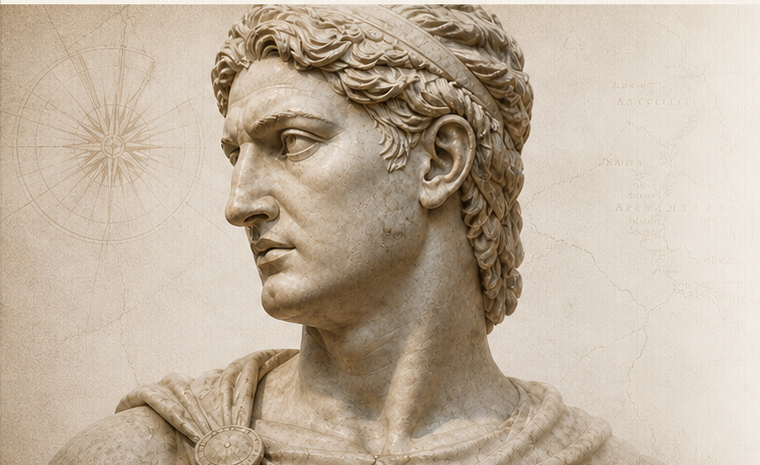
Alexander the Great
King of Macedonia, Hegemon of the Hellenic League, Pharaoh of Egypt, and King of Persia. Undefeated in battle, he established one of the largest empires in history spanning from Greece to northwestern India before dying mysteriously at age 32.
02
A
KAYIT
Alexander V
Alexander V may refer to:
03
A
KAYIT
Alexander Howland Smith
Alexander Howland Smith (16 March 1859 – 3 May 1913), also known as the "Antique Smith", was a Scottish document forger in the 1880s. His forgeries still surface today.
04
A
KAYIT
Alexander I
Alexander I may refer to:
05
A
KAYIT
Alexander Kerensky
Alexander Fyodorovich Kerensky ( – 11 June 1970) was a Russian lawyer and revolutionary who led the Russian Provisional Government and the short-lived Russian Republic for three months from late July to early November 1917.
06
A
KAYIT
Alexander Balas
Alexander I Theopator Euergetes, surnamed Balas (), was the ruler of the Seleucid Empire from 150 BC to August 145 BC. Picked from obscurity and supported by the neighboring Roman-allied Attalid kingdom, Alexander landed in Phoenicia in 152 BC and started a civil war against Seleucid King Demetrius I Soter. Backed by mercenaries and factions of the Seleucid Empire unhappy with the existing government, he defeated Demetrius and took the crown in 150 BC. He married the princess Cleopatra Thea t
07
A
KAYIT
Alexander of Pherae
Alexander () was Tyrant or Despot of Pherae in Thessaly, ruling from 369 to c. 356 BC. Following the assassination of Jason, the tyrant of Pherae and Tagus of Thessaly, in 370 BC, his brother Polyphron ruled for a year, but he was then poisoned by Alexander who assumed power himself. Alexander governed tyrannically and was constantly seeking to control Thessaly and the kingdom of Macedonia. He also engaged in piratical raids on Attica. Alexander was murdered by Tisiphonus, Lycophron and Peitho
08
A
KAYIT
Alexander Jagiellon
Alexander Jagiellon (; ; 5 August 1461 – 19 August 1506) of the House of Jagiellon was Grand Duke of Lithuania from 1492 and King of Poland from 1501 until his death in 1506. He was the fourth son of Casimir IV Jagiellon. He was elected grand duke of Lithuania upon the death of his father and king of Poland upon the death of his brother John I Albert.
09
A
KAYIT
Alexander III of Russia
Alexander III (; 10 March 18451 November 1894) was Emperor of Russia, King of Congress Poland and Grand Duke of Finland from 13 March 1881 until his death in 1894. He was highly reactionary in domestic affairs and reversed some of the liberal reforms of his father, Alexander II. This policy is known in Russia as "counter-reforms" (). Under the influence of Konstantin Pobedonostsev (1827–1907), he opposed any socio-economic moves that limited his autocratic rule.
10
A
KAYIT
Alexander I of Scotland
Alexander I (medieval Gaelic: Alaxandair mac Maíl Coluim; modern Gaelic: Alasdair mac Mhaol Chaluim; c. 1078 – 23 April 1124), posthumously nicknamed The Fierce, was the King of Scotland from 1107 to his death. He succeeded his brother, King Edgar, and his successor was his brother David. He was married to Sybilla of Normandy, an illegitimate daughter of Henry I of England.
11
A
KAYIT
Alexander II of Scotland
Alexander II (Medieval Gaelic: ; Modern Gaelic: ; 24 August 1198 – 6 July 1249) was King of Scotland from 1214 until his death. He concluded the Treaty of York (1237) which defined the boundary between England and Scotland, virtually unchanged today.
12
A
KAYIT
Alexander I of Serbia
Alexander I (; 14 August 187611 June 1903) reigned as the king of Serbia from 1889 to 1903 when he and his wife, Draga Mašin, were assassinated by a group of Royal Serbian Army officers, led by Captain Dragutin Dimitrijević.
13
A
KAYIT
Alexander III of Scotland
Alexander III (Medieval ; Modern Gaelic: ; 4 September 1241 – 19 March 1286) was King of Scots from 1249 until his death. He concluded the Treaty of Perth, by which Scotland acquired sovereignty over the Western Isles and the Isle of Man. His heir, Margaret, Maid of Norway, died before she could be crowned.
14
A
KAYIT
Alexander II
Alexander II may refer to:
15
A
KAYIT
Alexander III
Alexander III may refer to:
16
A
KAYIT
Alexander Jannaeus
Alexander Jannaeus ( ; Yannaʾy; born Jonathan ) was the second king of the Hasmonean dynasty, who ruled over an expanding kingdom of Judaea from 103 to 76 BCE. A son of John Hyrcanus, he inherited the throne from his brother Aristobulus I, and married his brother's widow, Queen Salome Alexandra. From his conquests to expand the kingdom to a bloody civil war, Alexander's reign has been generalised as cruel and oppressive with never-ending conflict. The major historical sources of Alexander's lif
17
A
KAYIT
Alexander IV
Alexander IV may refer to: Pope Alexander IV (1199 or –1261) Alexander IV of Macedon (323 BC–309 BC), son of Alexander the Great Alexander IV of Imereti (died 1695), of the Bagrationi Dynasty, king of Imereti (western Georgia)
18
A
KAYIT
Alexander Fleming
Sir Alexander Fleming (6 August 1881 – 11 March 1955) was a Scottish physician and microbiologist, best known for discovering the world's first broadly effective antibiotic substance, which he named penicillin. His discovery in 1928 of what was later named benzylpenicillin (or penicillin G) from the mould Penicillium rubens has been described as the "single greatest victory ever achieved over disease". For this discovery, he shared the Nobel Prize in Physiology or Medicine in 1945 with Howard F
19
A
KAYIT
Alexander Technique
The Alexander Technique, named after its developer Frederick Matthias Alexander (1869–1955), is a type of alternative therapy based on the idea that poor posture gives rise to a range of health problems. The American National Center for Complementary and Integrative Health classifies it as a "psychological and physical" complementary approach to health when used "together with" mainstream methods. When used "in place of" conventional medicine, it's considered "alternative".
20
A
KAYIT
Alexander Gibson
Alexander Gibson may refer to: